
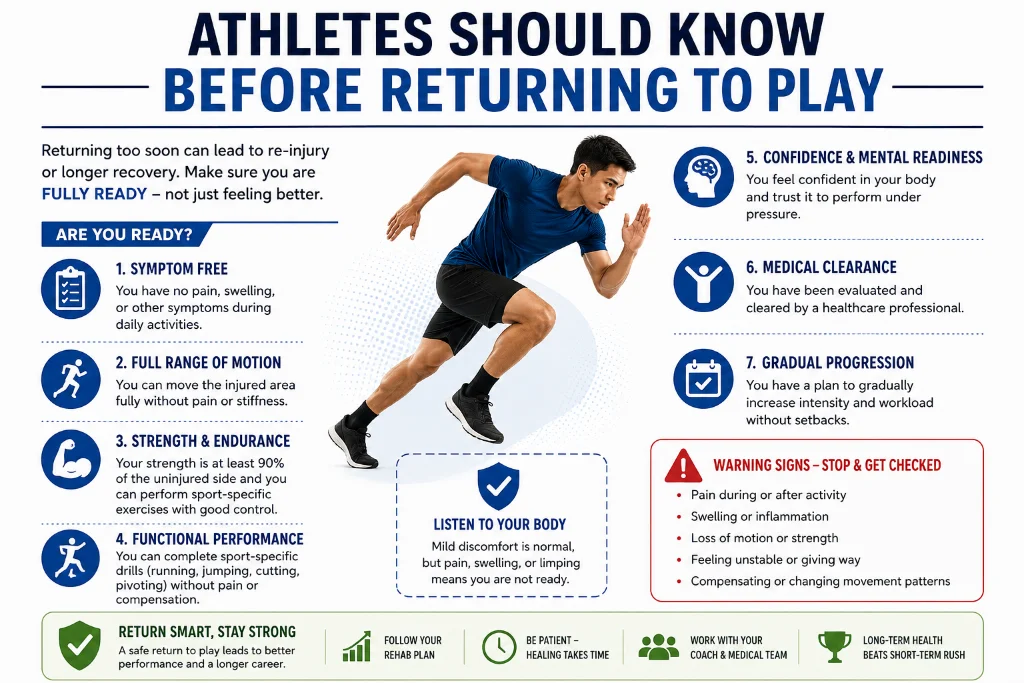
Every athlete knows the excitement of getting back on the field.
After weeks of rehabilitation, the pain has reduced, the swelling is gone, and walking feels normal again. It becomes tempting to believe that the injury is behind you.
But this is exactly where many athletes make their biggest mistake.
Pain-free does not always mean fully recovered.
An ankle may no longer hurt, but it might still lack balance. A knee may feel strong during walking but struggle during sprinting or sudden direction changes. A shoulder may lift comfortably overhead yet remain unstable during throwing.
Returning to sport before your body is truly ready can increase the risk of another injury—sometimes a more serious one than the first.
Sports injuries are becoming increasingly common as more Indians participate in cricket, football, badminton, tennis, marathon running, gym training, CrossFit, cycling, and recreational fitness. Research published in the Indian Journal of Orthopaedics and sports medicine literature shows that knee injuries, ankle sprains, hamstring strains, shoulder injuries, and ligament tears are among the most frequently reported sports-related problems. One of the biggest reasons athletes experience repeat injuries is returning to play before completing proper rehabilitation.
True Sports Injury Recovery is not simply about waiting for pain to disappear.
It is about rebuilding strength, restoring movement, improving confidence, and preparing the body to tolerate the demands of competition again.
At Genesis Sports Physiotherapy Clinic, Mumbai, Dr Raina Ranney helps recreational and competitive athletes recover through evidence-based Sports Physiotherapy, guiding them safely from injury back to performance while reducing the risk of reinjury.
Recovery Is a Journey—Not a Date on the Calendar
Many athletes ask the same question:
“When can I play again?”
A better question is:
“Is my body ready to play again?”
Two athletes with the same injury may recover at very different speeds.
Recovery depends on several factors, including:
- Type of injury
- Severity of tissue damage
- Age
- Overall fitness
- Previous injuries
- Quality of rehabilitation
- Consistency with exercises
- Sport-specific demands
- Mental confidence
- Sleep and nutrition
Rather than following a fixed timeline, physiotherapy focuses on achieving specific recovery milestones before progressing to higher levels of activity.
The Biggest Mistake Athletes Make After an Injury
One good training session often creates false confidence.
The athlete completes practice without pain and immediately returns to full competition.
Unfortunately, healing tissues may still lack:
- Strength
- Stability
- Coordination
- Power
- Endurance
- Reaction speed
- Balance
- Movement efficiency
These hidden deficits often become obvious only during high-speed movements such as sprinting, jumping, tackling, pivoting, or landing.
Returning too early places excessive stress on tissues that are still adapting.
The result may be another injury—or even surgery that might have been avoided.
Every Successful Comeback Follows Progressive Stages
Elite athletes rarely return directly from rest to competition.
Instead, recovery progresses through carefully planned stages.
Stage 1: Protect the Injured Area
Immediately after injury, the priorities are reducing pain, protecting healing tissues, and controlling swelling while maintaining as much safe movement as possible.
Depending on the injury, temporary activity modification or support devices may be recommended.
Stage 2: Restore Normal Movement
As healing progresses, attention shifts toward improving:
- Joint mobility
- Muscle flexibility
- Pain-free movement
- Walking pattern
- Functional range of motion
Regaining movement early helps reduce stiffness and prepares the body for strengthening.
Stage 3: Rebuild Strength
Muscles often weaken surprisingly quickly after injury.
Rehabilitation gradually restores:
- Muscle strength
- Core stability
- Joint support
- Endurance
- Balance
- Neuromuscular control
Exercises become progressively more challenging as healing continues.
Stage 4: Prepare for Your Sport
General fitness alone is not enough.
A football player needs different rehabilitation from a swimmer.
A badminton player moves differently from a marathon runner.
Sports Physiotherapy introduces exercises that replicate the physical demands of the athlete’s sport, including:
- Acceleration
- Deceleration
- Cutting movements
- Jumping
- Landing
- Rotational movements
- Sport-specific coordination
Only after these activities become comfortable does the athlete progress further.
Stage 5: Return with Confidence
Returning to competition is the final stage—not the first.
Before clearance, the athlete should demonstrate that the body can tolerate training demands safely while maintaining good movement quality and confidence.
The objective is not simply participating again.
It is performing confidently without unnecessary risk.
Being Fit and Being Match-Ready Are Completely Different
Many athletes maintain excellent cardiovascular fitness while recovering.
However, match fitness involves much more than endurance.
Competitive sport demands:
- Quick reactions
- Explosive acceleration
- Powerful jumping
- Sudden braking
- Direction changes
- Body control
- Balance under pressure
- Coordination
- Decision-making while moving
An athlete may complete a five-kilometre run comfortably but still struggle to safely pivot during a football match or land after a basketball rebound.
Sports Physiotherapy bridges this gap by preparing the athlete for the actual demands of competition—not just general exercise.
Can Your Body Handle Match-Day Demands Again?
Before returning to unrestricted sport, physiotherapists often evaluate how the body performs under progressively challenging conditions.
Depending on the injury and sport, assessment may include:
- Single-leg balance
- Controlled squats
- Hop testing
- Jump landing mechanics
- Sprint progression
- Side-to-side movement
- Agility drills
- Direction changes
- Endurance testing
- Confidence during movement
These assessments help determine whether rehabilitation has restored the qualities required for safe participation.
Passing a timeline is less important than passing functional movement goals.
Some Injuries Return Because the Original Cause Was Never Corrected
The painful tissue is not always the real problem.
For example:
- Repeated ankle sprains may result from poor balance.
- Shoulder injuries may develop because of weak shoulder blade muscles.
- Knee pain may begin with poor hip control.
- Hamstring strains may occur due to muscle imbalance or inadequate sprint mechanics.
Treating only the painful area may reduce symptoms temporarily but may not address the movement pattern that contributed to the injury.
Long-term recovery requires identifying and correcting these underlying factors.
The Mental Side of Recovery Is Just as Important
Physical healing is only one part of rehabilitation.
Many athletes experience hesitation after an injury.
Questions such as:
“Will my knee give way again?”
“Can I sprint at full speed?”
“What if I get injured again?”
These concerns are completely understandable.
A structured rehabilitation programme gradually rebuilds confidence through progressive movement challenges, allowing athletes to trust their bodies again before returning to competition.
Confidence grows through preparation—not through hope alone.
Winning the Recovery Is Just as Important as Winning the Match
Missing training because of an injury can be frustrating.
However, returning before your body is fully prepared may keep you away from the sport even longer.
The goal of rehabilitation is not simply to get you back on the field quickly.
The goal is to help you stay there.
A well-planned Sports Injury Recovery programme reduces unnecessary risk while helping athletes rebuild the physical qualities needed for long-term performance.
How Sports Physiotherapy Helps You Return Stronger—Not Just Sooner
Every injury changes the way your body moves.
Sometimes the changes are obvious, such as limping after an ankle sprain.
Sometimes they are subtle, like favouring one leg while jumping or shifting more weight onto the opposite side.
These small movement changes can remain even after the pain disappears.
Sports physiotherapy focuses on identifying and correcting these hidden deficits before they lead to another injury.
Depending on the injury and the athlete’s sport, rehabilitation may include:
- Joint mobility restoration
- Progressive strength training
- Neuromuscular re-education
- Dynamic balance exercises
- Core stability training
- Running mechanics
- Landing technique correction
- Plyometric progression
- Agility drills
- Sport-specific conditioning
Every exercise is introduced according to healing, movement quality, and functional progress—not simply according to the number of weeks since the injury.
One Rehabilitation Plan Doesn’t Work for Every Sport
A marathon runner, swimmer, footballer, and badminton player all place different demands on their bodies.
That is why rehabilitation should reflect the movements required in the athlete’s sport.
Football
Focus may include:
- Sprint acceleration
- Sudden direction changes
- Kicking mechanics
- Single-leg stability
- Landing control
Cricket
Training may address:
- Bowling mechanics
- Throwing control
- Shoulder endurance
- Rotational strength
- Fielding movements
Badminton and Tennis
Rehabilitation often emphasises:
- Lateral movement
- Explosive lunges
- Shoulder stability
- Wrist control
- Court agility
Running
The programme may include:
- Running gait assessment
- Cadence training
- Hip and glute strengthening
- Load progression
- Return-to-distance planning
Sport-specific rehabilitation prepares athletes for the movements they actually perform during competition.
Preventing the Next Injury Starts Before the Current One Ends
Recovery should always include injury prevention.
Once athletes begin feeling better, they often stop performing rehabilitation exercises altogether.
Unfortunately, this is when weaknesses may gradually return.
A complete rehabilitation programme should also teach athletes how to reduce future injury risk through:
- Proper warm-up routines
- Mobility maintenance
- Progressive strength training
- Recovery planning
- Training load management
- Flexibility exercises
- Technique correction
- Adequate rest between sessions
Strong athletes are not necessarily injury-free.
Athletes who recover well, train intelligently, and respect recovery are often better prepared for long-term performance.
Training Hard Means Nothing If Recovery Is Poor
Many athletes carefully plan their workouts but pay little attention to recovery.
The body improves during recovery—not during the training session itself.
Several lifestyle factors influence healing, including:
Quality Sleep
Muscle repair and tissue recovery occur primarily during sleep.
Poor sleep may delay recovery and reduce athletic performance.
Balanced Nutrition
Protein, carbohydrates, healthy fats, vitamins, and minerals all contribute to tissue healing and energy production.
Hydration
Even mild dehydration can reduce physical performance and delay recovery after intense exercise.
Managing Training Load
Increasing intensity too quickly is a common reason athletes become injured again.
Gradual progression allows muscles, tendons, ligaments, and joints to adapt safely.
Guided Sports Rehabilitation by Dr Raina Ranney
At Genesis Sports Physiotherapy Clinic, Mumbai, sports rehabilitation is led by Dr Raina Ranney, who combines advanced clinical knowledge with a strong understanding of movement, performance, and injury prevention.
Dr. Raina completed her undergraduate degree in Physiotherapy from D. Y. Patil College before earning a Master’s Degree in Musculoskeletal Physiotherapy from the University of Melbourne, Australia.
Her advanced musculoskeletal training enables her to evaluate movement patterns, muscle imbalances, joint mechanics, and functional performance in athletes across different sports.
Rather than focusing only on the injured area, she evaluates the body as a complete movement system.
Her rehabilitation programmes aim to:
- Restore movement quality
- Improve muscular strength
- Build joint stability
- Enhance coordination
- Reduce reinjury risk
- Improve confidence before returning to competition
- Support long-term athletic performance
Every rehabilitation programme is designed according to the athlete’s sport, goals, and stage of recovery.
Where Science Meets Performance?
Established in Mumbai in 2012, Genesis Sports Physiotherapy Clinic has helped more than 1,000 patients recover from injuries and return to active lifestyles.
Athletes choose Genesis because rehabilitation focuses on both recovery and future performance.
Treatment may include:
- Comprehensive movement assessment
- Evidence-based Sports Physiotherapy
- Hands-on manual therapy
- Functional strengthening
- Balance and proprioception training
- Plyometric progression
- Sport-specific rehabilitation
- Return-to-play assessment
- Injury prevention strategies
- Individual exercise programmes
The objective is not simply to remove pain.
It is to prepare the athlete for the physical demands of competition while reducing the likelihood of another injury.
The Strongest Comebacks Are Built Before the First Match Back
A successful return to sport is not measured by the date you resume training.
It is measured by your ability to move confidently, perform consistently, and stay injury-free throughout the season.
Investing time in complete rehabilitation today may help protect your performance tomorrow.
If you’re recovering from a sports injury and looking for expert Sports Injury Recovery, evidence-based Sports Physiotherapy, or a trusted Sports Physiotherapy Clinic in Mumbai, consult Dr Raina Ranney at Genesis Sports Physiotherapy Clinic.
Recover with purpose. Train with confidence. Return stronger than before.
Faqs
1. Can I return to sport if I have no pain while walking?
Walking comfortably is an encouraging sign, but most sports require sprinting, jumping, cutting, or rapid changes of direction. These higher-level movements should also be assessed before returning to play.
2. Is wearing a brace enough to prevent another injury?
A brace may provide temporary support in certain situations, but it cannot replace strength, balance, coordination, and proper rehabilitation.
3. Why do athletes get injured again in the same place?
Repeat injuries often occur because underlying weaknesses, movement faults, poor training progression, or inadequate rehabilitation were never fully addressed.
4. Should I keep training other body parts while injured?
In many cases, yes. A physiotherapist can modify your training programme so you maintain general fitness without placing unnecessary stress on the injured area.
5. How do I know if I’m psychologically ready to compete again?
Confidence usually improves when athletes successfully complete progressive rehabilitation, sport-specific drills, and return-to-play testing without fear or hesitation.
6. Is soreness after rehabilitation exercises normal?
Mild muscle soreness can occur as strength improves. However, increasing joint pain, swelling, or sharp pain should be discussed with your physiotherapist.
7. Do professional athletes recover differently from recreational athletes?
The principles of tissue healing remain the same. The main difference is often access to structured rehabilitation, recovery planning, and close monitoring.
8. Can Sports Physiotherapy improve performance even after recovery?
Yes. Many athletes continue sports physiotherapy to improve movement efficiency, strength, flexibility, balance, and injury prevention after completing rehabilitation.